Toyota North America
Ethnographic Research in New York City for Toyota's Pedestrian Safety Initiative
Ethnographic field research with Toyota North America, studying pedestrian behavior in NYC to challenge assumptions in urban safety system design.
Team
Individual
What I did
UX Research · Ethnographic Research · Contextual Inquiry
Skills
Ethnography · Field Research · Contextual Inquiry · Insight Synthesis
Tools
Figma · FigJam · Panelfox

The brief arrived as a broad question about pedestrian safety in cities. I narrowed it. Most safety research focuses on rule-following behavior. I was more interested in rule-breaking: specifically, why jaywalking in New York functions as a coherent, learned system rather than chaos. That reframe shaped every methodological choice that followed.
The Who and The Why
Jaywalking is now decriminalized in New York City. However, the safety problem didn't go away.
Decriminalization doesn't affect everyone equally. Who you are and how long you've lived here determines whether this change means freedom, confusion, or continued inequity.

Who it affects
Native New Yorkers
Already jaywalking. It's second nature. They rely on instinct and years of experience to navigate efficiently and safely.
New Residents and Visitors
Unfamiliar with NYC pedestrian culture and more likely to misjudge risk without the local heuristics that experienced residents have built over years.
Marginalized Communities
Historical enforcement disproportionately targeted Black and Latino communities. The law changed but the systemic context it operated within did not.
Why it matters
Safety
Skilled jaywalking can be efficient, but creates real risk for pedestrians unfamiliar with NYC's traffic patterns and pace.
Urban Equity
Decriminalization reduces unfair penalties but raises new questions about who has access to the knowledge needed to navigate safely.
Cultural Preservation
Jaywalking isn't just a shortcut. It represents the city's adaptability and quick thinking, a form of urban identity.
Research Question
How might we preserve the art of jaywalking in New York City while prioritizing pedestrian safety?
I prioritized methods that observed behavior over asking about it.
Self-reported accounts of street navigation differ significantly from what actually happens in real time. The research design reflected that.

Field Observations
Conducted at two distinct NYC locations. I observed jaywalking behaviors and traffic dynamics without intervening, looking for naturalistic patterns: who hesitates, who leads, who never checks the signal.
Interviews
Five participants, a mix of long-term residents and recent arrivals. Locals often struggled to articulate their decision-making because it had become automatic. Newcomers could describe theirs in detail precisely because it hadn't.
Contextual Inquiries
I shadowed two individuals during their actual walks, one a longtime New Yorker, one a recent arrival. Watching someone decide whether to cross is a fundamentally different dataset than hearing them describe it afterward.
Three patterns emerged that reframed the design problem.
01
Awareness over compliance
Experienced pedestrians don't follow signals. They read traffic. Jaywalking functions as a learned system of continuous environmental scanning. Most locals couldn't describe what they were doing because it had become automatic.
“I cross when I'm not supposed to all the time. It's really the only way to get around the city without wasting time.”
Local
02
Navigation by social proxy
Newcomers compensate for unfamiliarity by following other pedestrians, outsourcing risk assessment in real time. This creates a dependency chain: the newcomer trusts the local, whose judgment may not be safe for someone without their contextual knowledge.
“I'm new to NYC and find navigating confusing, so I usually just wait for someone else to cross and blindly cross with them. In hindsight, putting so much trust in them is probably not the safest idea.”
Newcomer
03
Vigilance normalized as habit
Both groups described themselves as comfortable navigating the city. Both also described elaborate routines built around managing discomfort: avoided blocks, preferred crowds, adjusted timing. The stress was there. It had just been reclassified as normal.
“I didn't even realize jaywalking was illegal until it became legal. It's just a part of being in New York.”
Local
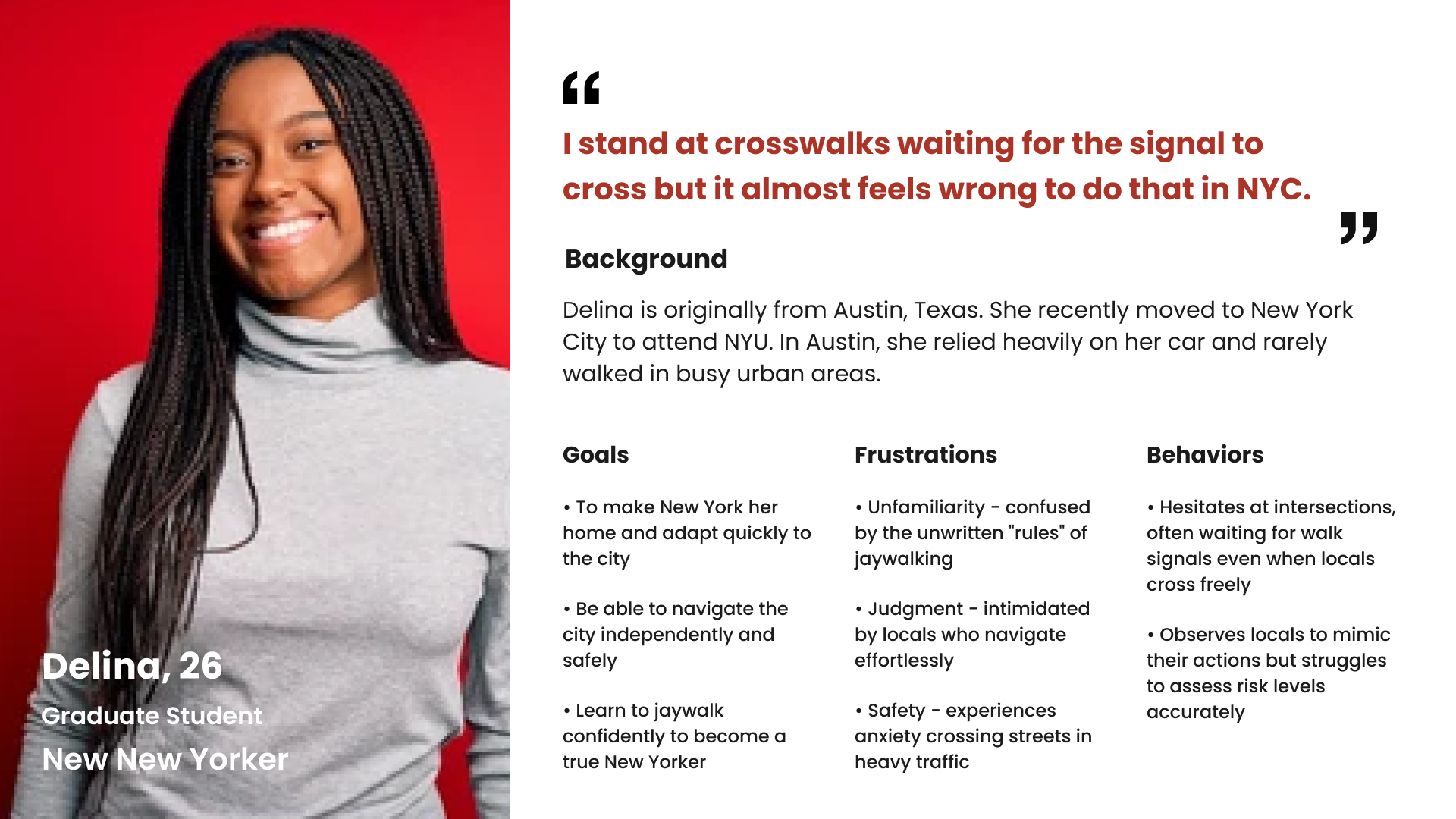
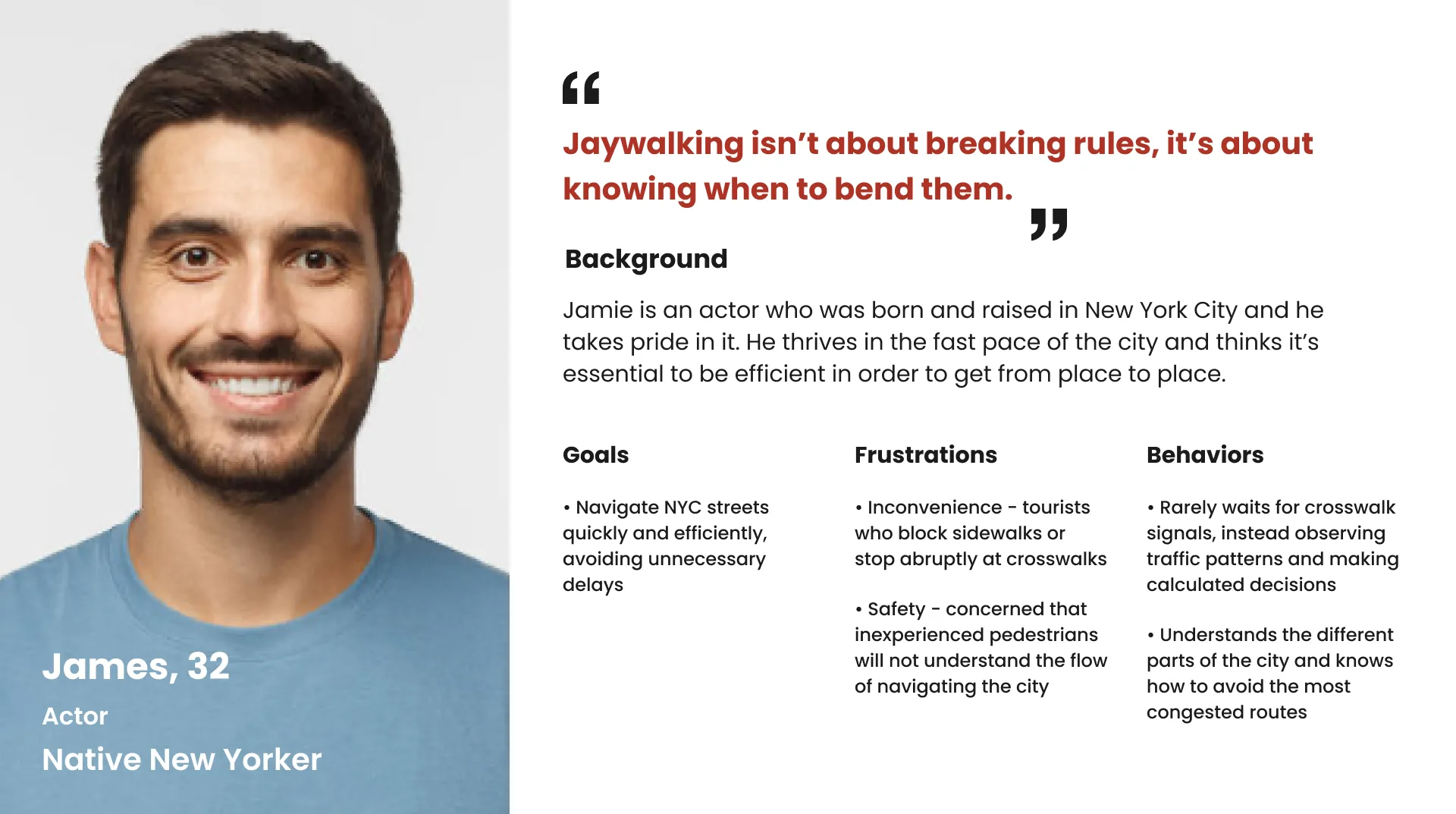
Two archetypes anchored the design direction.
Delina represents the newcomer navigating by social proxy. James represents the native whose expertise is invisible to him. Both informed the design constraint: any solution had to work for one without disrupting the other.
The New Pedestrian Integration System.
Research surfaced one core opportunity: the street already works for people who have learned it. The problem is legibility for those who haven't. These three speculative concepts explore how to close that gap without disrupting the flow locals depend on.
New Pedestrian Holographic Badges
Hovering holograms display a visible badge above pedestrians new to the city, similar to new-driver stickers, signaling to traffic and experienced walkers that someone may need more time.
Smart Crosswalks
Badges sync with citywide sensors to extend crossing windows dynamically in areas with higher concentrations of new pedestrians.
Incentivized Mobile App
An educational companion for navigating NYC streets. Completing safety modules earns real incentives like free subway rides or coffee, making it worth doing before you need it.
Shaping My Approach
The gap between what people say and what they do.
The most significant methodological learning from this project was the gap between self-report and observed behavior. Participants consistently described themselves as comfortable navigating the city while simultaneously revealing complex avoidance strategies and stress responses embedded in their daily routines.
Direct questioning is insufficient for uncovering stressors that have been normalized. Observation and shadowing surfaces what interviews cannot. If I were conducting this study again, I would weight contextual inquiry more heavily from the start.